Humanising BHP’s recruitment story
deliverables:
Recruitment experience
Role:
Senior design lead, experience
challenge
BHP's careers site was information-heavy but impersonal. The corporate content was there. Structure, opportunities, benefits. But the human side wasn't. Candidate stories, country-specific context and the texture of what working at BHP actually felt like were missing. What existed felt transactional. Candidates were being pushed toward applications before they have had a reason to trust the organisation. The experience needed both new content and a better sequence to deliver it.
Problem statement
How might we craft a candidate-centric experience that communicates our culture with clarity, highlights the benefits that matter, and seamlessly transitions future employees into the recruitment funnel?
Design Approach
The solution wasn't to create separate experiences for each audience type. It was to reorder the journey. Culture and narrative came first so candidates could absorb who BHP was before being asked to do anything. Role-specific pathways came after. Once someone understood the organisation, moving into the funnel felt natural rather than pressured.
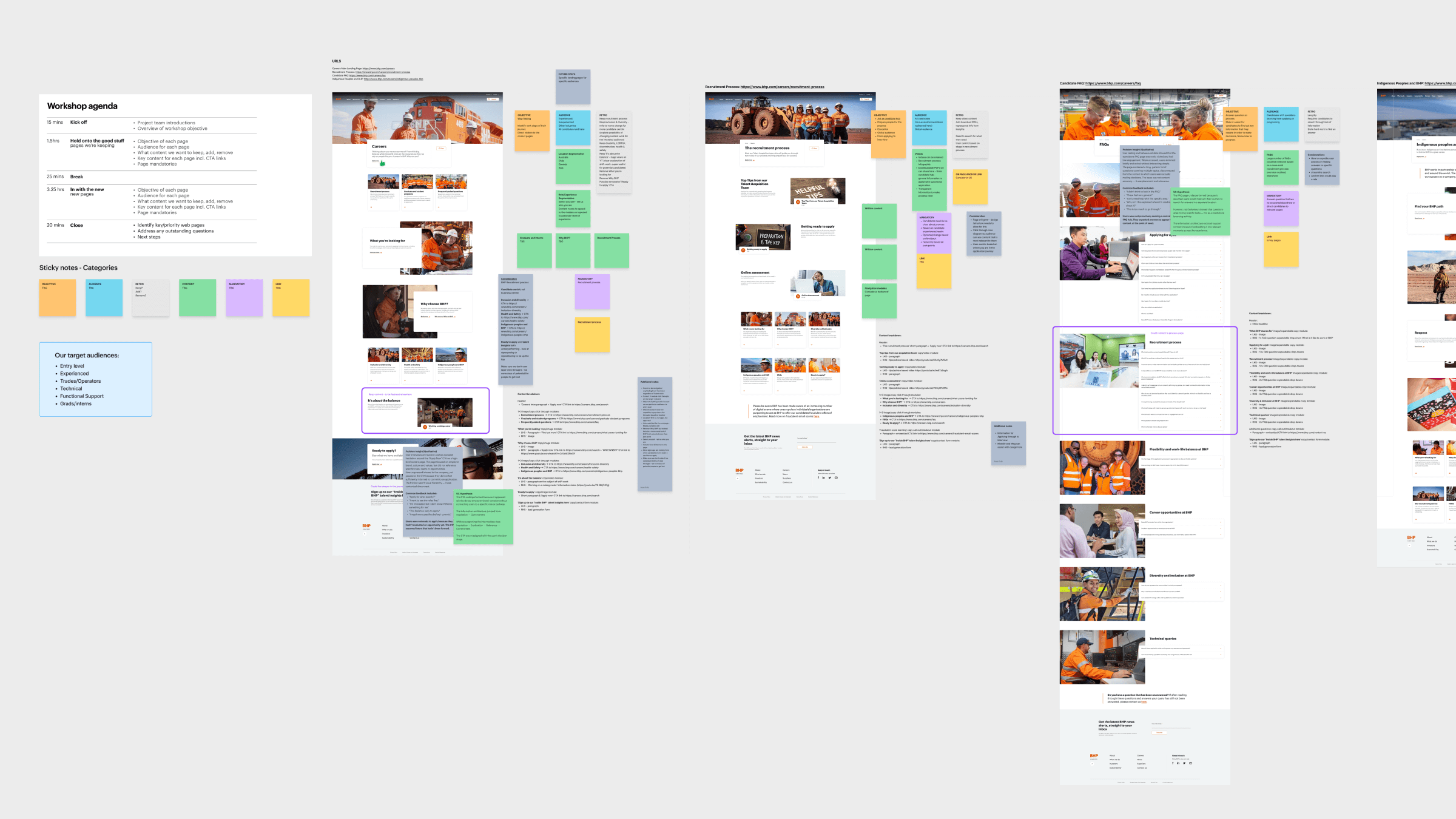
Workshop and auditing session with key stakeholders
Insight-led UX refinements
User journey
During the explore phase, we ran stakeholder interviews, candidate journey audits and content reviews to understand how varied audiences assessed trust before taking action, while aligning internal teams around a shared vision for the experience. These insights shaped a journey map that balanced emotional readiness with functional needs. Culture, values and employee stories were surfaced early to build credibility, followed by benefits and career pathways once confidence grew. Recruitment actions such as job alerts, eDM sign-ups and role search were introduced progressively, enabling candidates to engage at their own pace rather than feeling pushed too soon.
Sitemapping
One entry point. SIX regions.
The global structure added another layer. Candidates needed to navigate across six regions; Canada, Chile, Malaysia, Philippines, Australia and rest of world without feeling fragmented. We repurposed the existing three-up tile module into a six-tile navigational gateway on the global careers page. Candidates selected their region then were guided into region-specific career pathways. The module wasn't designed as navigation originally but it solved the problem cleanly within the existing system.
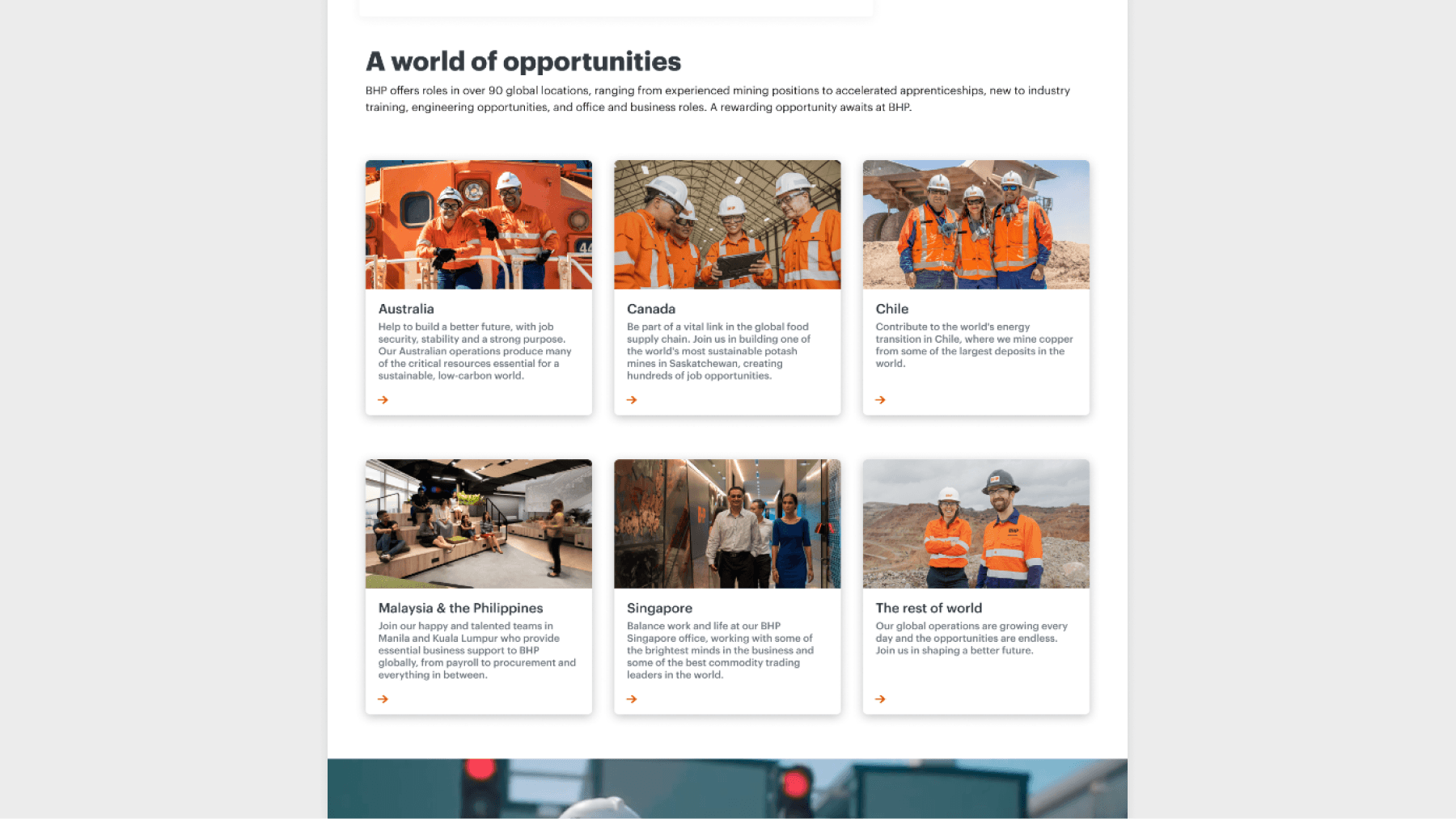
Navigational gateway
information architecture
Insights from exploration were distilled into a clear, focused information architecture that prioritised trust over volume. We simplified the structure, removing corporate language and unnecessary depth to centre on what candidates genuinely needed to understand about BHP as an employer. Content was organised to feel human and approachable rather than promotional. The framework stayed consistent across roles and regions while allowing for local nuance. This clarity reduced cognitive load, strengthened credibility and kept the experience usable for a wide range of audiences.
Mid fidelity wireframing
Stakeholder Alignment
Coordinating across legal, engineering, and brand meant every decision needed to hold up across competing agendas. Legal needed visibility over consent moments. Engineering needed patterns that mapped to their existing module library. Brand needed tone consistent across all touchpoints. Framing decisions around what each team needed to solve made alignment faster which meant the solution was buildable, compliant, and on-brand before it reached development.
Mid fidelity wireframing
Inclusive representation
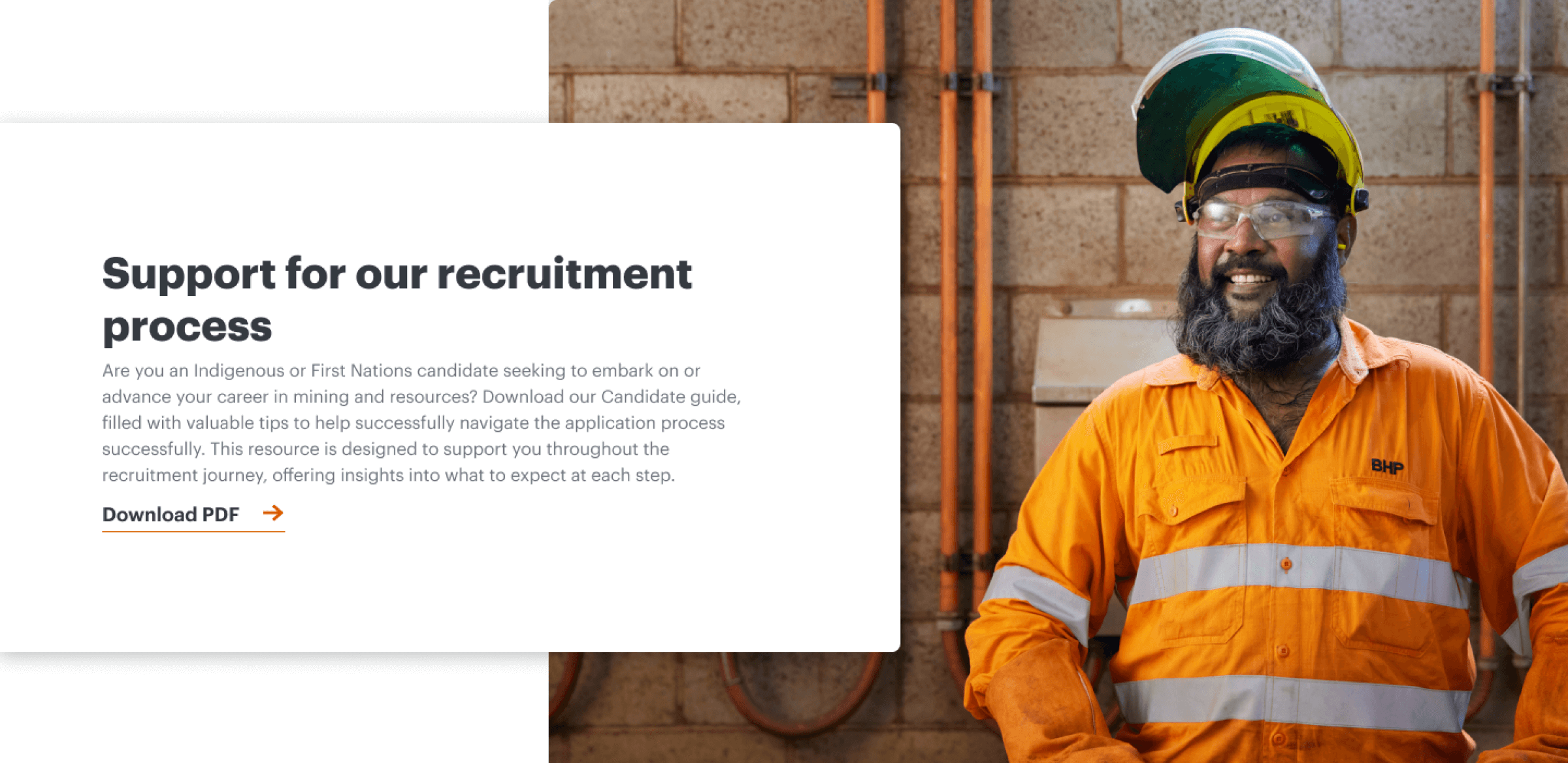
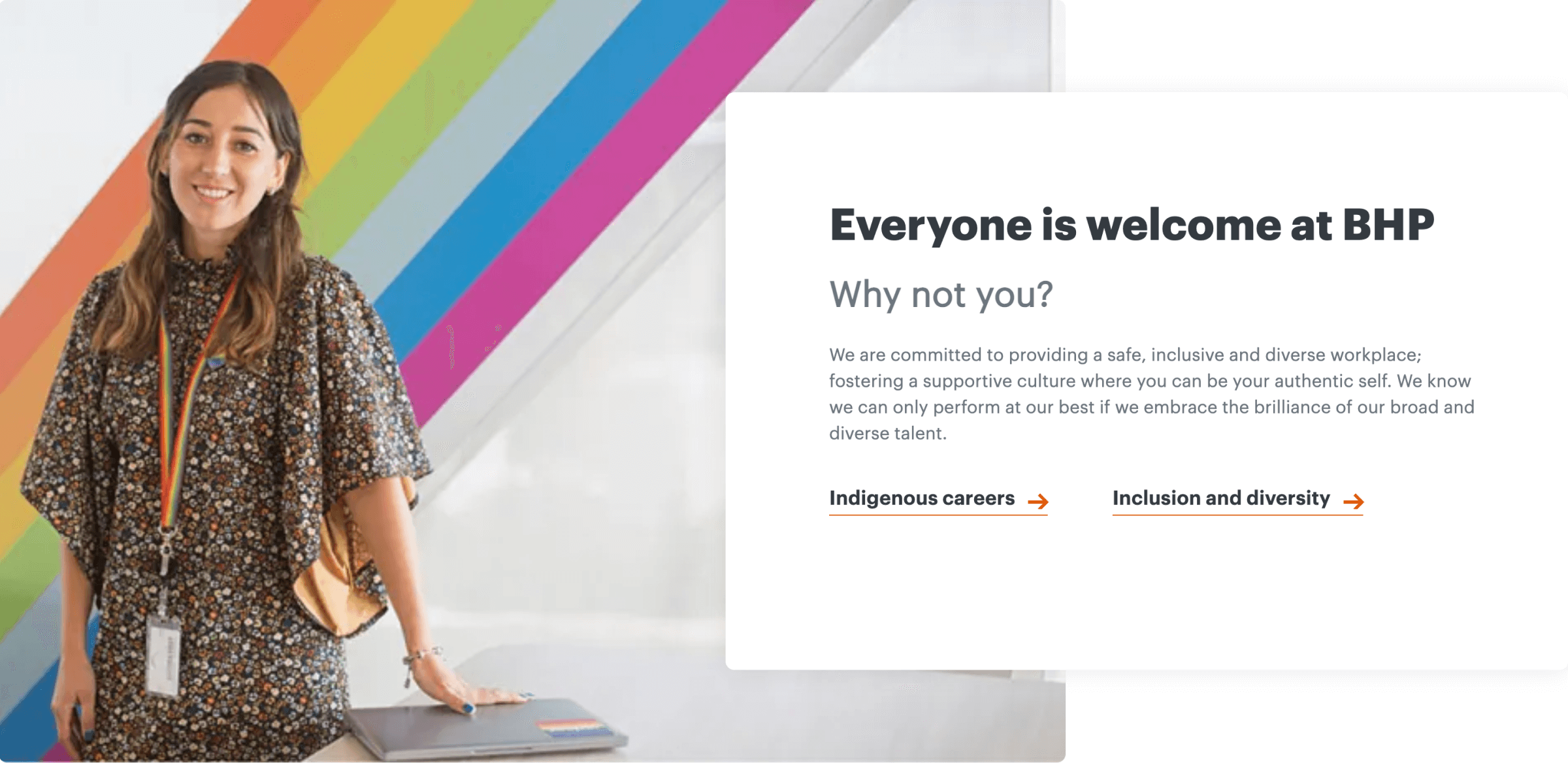
Visual and content decisions were made with care to reflect diversity, gender balance and equality in a natural and credible way. Representation was treated as part of the experience, not a message layered on top, helping reinforce BHP’s values without relying on statements or slogans.
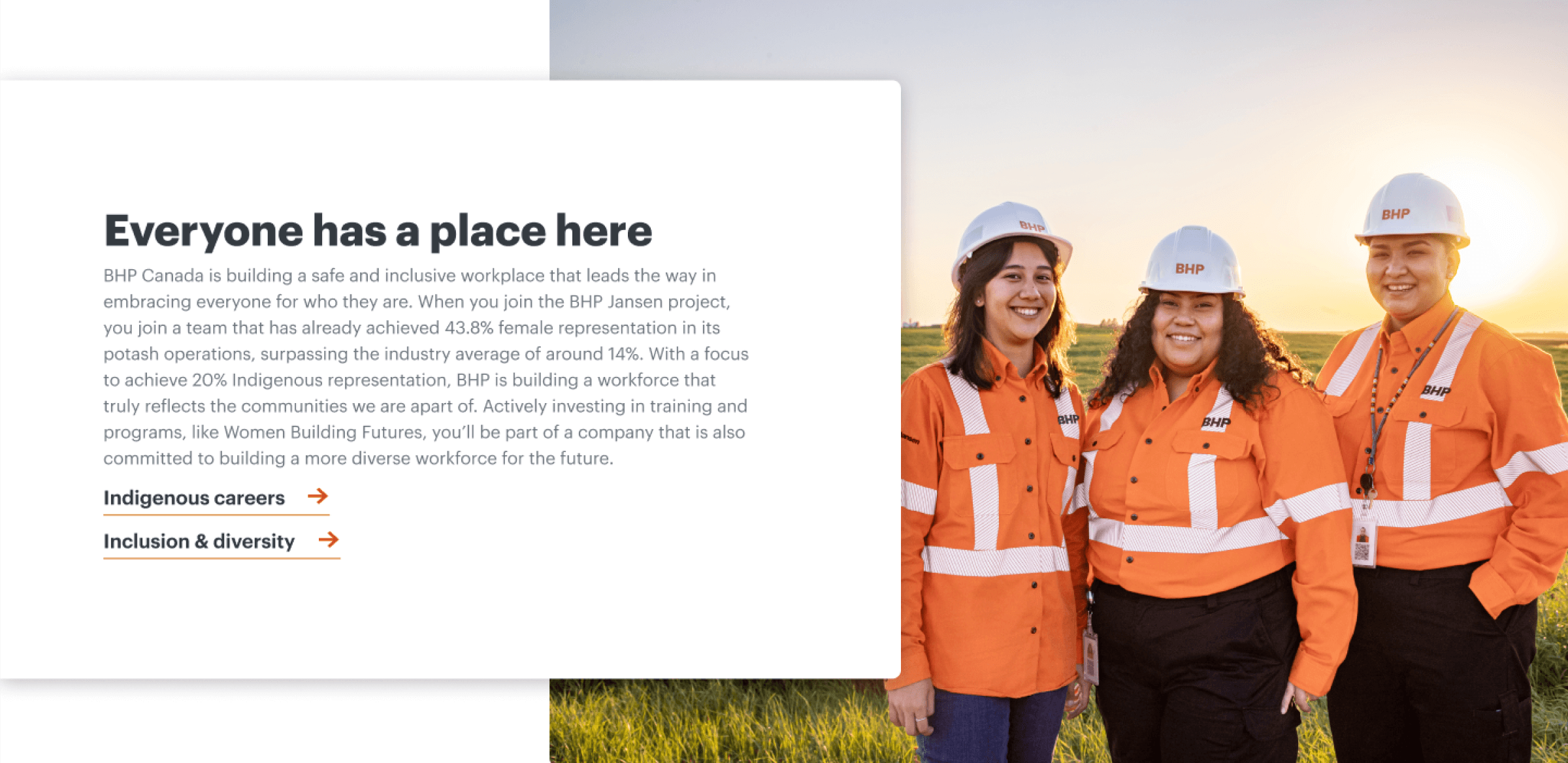
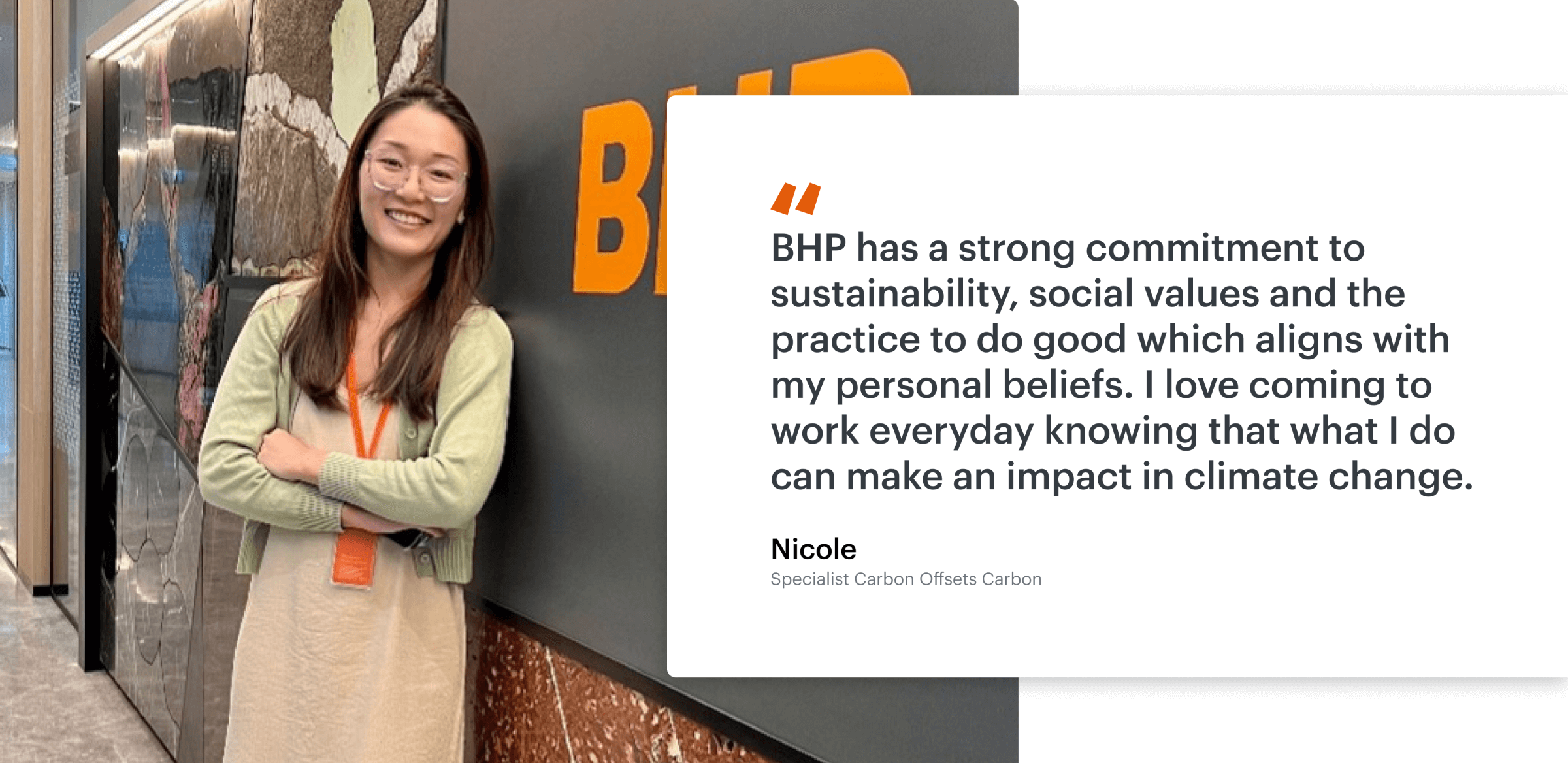
Static and video assets selection
Impact
The objectives were realised through strong user journey mapping and narrative led design that built trust with candidates and supported a strong global intake of talent for BHP. Visual representation reinforced gender balance and equality as a core organisational value. This project was delivered live within budget and aligned with the client’s business goals, resulting in a functional, scalable and results-driven outcome for all stakeholders.


Female representation reached 41.3% globally
43% improvement in average time on page
More candidates set up job alerts

Crafting brands with clarity.
Copyright © 2026 Brian Foo. All rights reserved.
Humanising BHP’s recruitment story
deliverables:
Recruitment experience
Role:
Senior design lead, experience
challenge
BHP's careers site was information-heavy but impersonal. The corporate content was there. Structure, opportunities, benefits. But the human side wasn't. Candidate stories, country-specific context and the texture of what working at BHP actually felt like were missing. What existed felt transactional. Candidates were being pushed toward applications before they have had a reason to trust the organisation. The experience needed both new content and a better sequence to deliver it.
Problem statement
How might we craft a candidate-centric experience that communicates our culture with clarity, highlights the benefits that matter, and seamlessly transitions future employees into the recruitment funnel?
Design Approach
The solution wasn't to create separate experiences for each audience type. It was to reorder the journey. Culture and narrative came first so candidates could absorb who BHP was before being asked to do anything. Role-specific pathways came after. Once someone understood the organisation, moving into the funnel felt natural rather than pressured.
Workshop and auditing session with key stakeholders
Insight-led UX refinements
User journey
During the explore phase, we ran stakeholder interviews, candidate journey audits and content reviews to understand how varied audiences assessed trust before taking action, while aligning internal teams around a shared vision for the experience. These insights shaped a journey map that balanced emotional readiness with functional needs. Culture, values and employee stories were surfaced early to build credibility, followed by benefits and career pathways once confidence grew. Recruitment actions such as job alerts, eDM sign-ups and role search were introduced progressively, enabling candidates to engage at their own pace rather than feeling pushed too soon.
Sitemapping
One entry point. SIX regions.
The global structure added another layer. Candidates needed to navigate across six regions; Canada, Chile, Malaysia, Philippines, Australia and rest of world without feeling fragmented. We repurposed the existing three-up tile module into a six-tile navigational gateway on the global careers page. Candidates selected their region then were guided into region-specific career pathways. The module wasn't designed as navigation originally but it solved the problem cleanly within the existing system.
Navigational gateway
information architecture
Insights from exploration were distilled into a clear, focused information architecture that prioritised trust over volume. We simplified the structure, removing corporate language and unnecessary depth to centre on what candidates genuinely needed to understand about BHP as an employer. Content was organised to feel human and approachable rather than promotional. The framework stayed consistent across roles and regions while allowing for local nuance. This clarity reduced cognitive load, strengthened credibility and kept the experience usable for a wide range of audiences.
Mid fidelity wireframing
Stakeholder Alignment
Coordinating across legal, engineering, and brand meant every decision needed to hold up across competing agendas. Legal needed visibility over consent moments. Engineering needed patterns that mapped to their existing module library. Brand needed tone consistent across all touchpoints. Framing decisions around what each team needed to solve made alignment faster which meant the solution was buildable, compliant, and on-brand before it reached development.
Mid fidelity wireframing
Inclusive representation
Visual and content decisions were made with care to reflect diversity, gender balance and equality in a natural and credible way. Representation was treated as part of the experience, not a message layered on top, helping reinforce BHP’s values without relying on statements or slogans.
Static and video assets selection
Impact
The objectives were realised through strong user journey mapping and narrative led design that built trust with candidates and supported a strong global intake of talent for BHP. Visual representation reinforced gender balance and equality as a core organisational value. This project was delivered live within budget and aligned with the client’s business goals, resulting in a functional, scalable and results-driven outcome for all stakeholders.
Female representation reached 41.3% globally
43% improvement in average time on page
More candidates set up job alerts

Crafting brands with clarity.
Copyright © 2026 Brian Foo. All rights reserved.
Humanising BHP’s recruitment story
deliverables:
Recruitment experience
Role:
Senior design lead, experience
challenge
BHP's careers site was information-heavy but impersonal. The corporate content was there. Structure, opportunities, benefits. But the human side wasn't. Candidate stories, country-specific context and the texture of what working at BHP actually felt like were missing. What existed felt transactional. Candidates were being pushed toward applications before they have had a reason to trust the organisation. The experience needed both new content and a better sequence to deliver it.
Problem statement
How might we craft a candidate-centric experience that communicates our culture with clarity, highlights the benefits that matter and seamlessly transitions future employees into the recruitment funnel?
Design Approach
The solution wasn't to create separate experiences for each audience type. It was to reorder the journey. Culture and narrative came first so candidates could absorb who BHP was before being asked to do anything. Role-specific pathways came after. Once someone understood the organisation, moving into the funnel felt natural rather than pressured.
Workshop and auditing session with key stakeholders
Insight-led UX refinements
User journey
During the explore phase, we ran stakeholder interviews, candidate journey audits and content reviews to understand how varied audiences assessed trust before taking action, while aligning internal teams around a shared vision for the experience. These insights shaped a journey map that balanced emotional readiness with functional needs. Culture, values and employee stories were surfaced early to build credibility, followed by benefits and career pathways once confidence grew. Recruitment actions such as job alerts, eDM sign-ups and role search were introduced progressively, enabling candidates to engage at their own pace rather than feeling pushed too soon.
Sitemapping
One entry point. SIX regions.
The global structure added another layer. Candidates needed to navigate across six regions; Canada, Chile, Malaysia, Philippines, Australia and rest of world without feeling fragmented. We repurposed the existing three-up tile module into a six-tile navigational gateway on the global careers page. Candidates selected their region then were guided into region-specific career pathways. The module wasn't designed as navigation originally but it solved the problem cleanly within the existing system.
Navigational gateway
information architecture
Insights from exploration were distilled into a clear, focused information architecture that prioritised trust over volume. We simplified the structure, removing corporate language and unnecessary depth to centre on what candidates genuinely needed to understand about BHP as an employer. Content was organised to feel human and approachable rather than promotional. The framework stayed consistent across roles and regions while allowing for local nuance. This clarity reduced cognitive load, strengthened credibility and kept the experience usable for a wide range of audiences.
Low fidelity wireframing
Stakeholder Alignment
Coordinating across legal, engineering, and brand meant every decision needed to hold up across competing agendas. Legal needed visibility over consent moments. Engineering needed patterns that mapped to their existing module library. Brand needed tone consistent across all touchpoints. Framing decisions around what each team needed to solve made alignment faster which meant the solution was buildable, compliant and on-brand before it reached development.
High-fidelity wireframes
Inclusive representation
Visual and content decisions were made with care to reflect diversity, gender balance and equality in a natural and credible way. Representation was designed into the experience itself rather than communicated through surface messaging, allowing BHP’s values to be demonstrated through structure, content and interaction.
Static and video assets selection
Impact
The objectives were realised through strong user journey mapping and narrative led design that built trust with candidates and supported a strong global intake of talent for BHP. Visual representation reinforced gender balance and equality as a core organisational value. This project was delivered live within budget and aligned with the client’s business goals, resulting in a functional, scalable and results-driven outcome for all stakeholders.
Female representation reached 41.3% globally
43% improvement in average time on page
More candidates set up job alerts

Crafting brands with clarity.
Copyright © 2026 Brian Foo. All rights reserved.